The Mental Health Ecosystem: Why it’s not just “in your head”
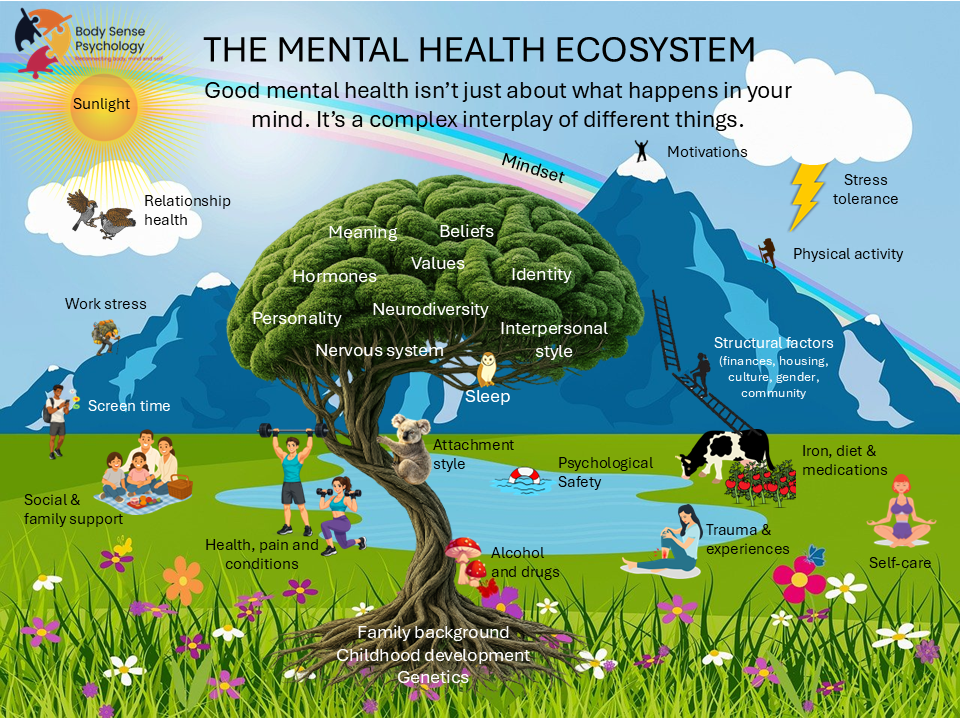
When people struggle with their mental health, the most common conclusion they reach is:
“Something is wrong with me.”
But mental health is rarely about a single flaw, weakness, or diagnosis. It’s an ecosystem. Just like a natural ecosystem, your mental health is shaped by multiple interacting factors — biological, psychological, relational, and environmental. When one part shifts, the whole system feels it. Understanding this can be deeply relieving. It moves us away from blame and toward clarity.
Mental Health Is a Living System
In an ecosystem, there isn’t one cause for change. If a tree begins to struggle, we don’t assume the tree is defective. We look at:
Soil quality
Water levels
Sunlight
Climate
Surrounding plant life
Root stability
Disease exposure
Mental health works the same way. If you’re feeling anxious, low, reactive, disconnected, or overwhelmed, the question isn’t: “What’s wrong with me?” It’s: “What’s happening in my system?”
The Roots: Early Development & Biology
At the base of your ecosystem are factors you didn’t choose:
Genetics
Childhood development
Family background
Attachment patterns
Early relational safety (or lack of it)
These shape how your nervous system responds to stress and connection. Your biology also plays a significant role:
Hormones
Neurodiversity
Sleep
Chronic health conditions
Pain and inflammation
Nutrient levels
Medication effects
These aren’t character flaws. They’re physiological influences.
The Trunk: Your Nervous System
Your nervous system is the central regulator of your emotional world. If it is frequently in fight-or-flight mode, you may experience:
Anxiety
Irritability
Sensory overwhelm
Hypervigilance
If it shifts toward shutdown, you may feel:
Flat
Disconnected
Unmotivated
Depressed
Mental health is often about regulation capacity, not willpower.
The Branches: Thoughts, Beliefs & Identity
Higher up in the system are your internal world factors:
Beliefs
Self-esteem
Identity
Meaning and values
Maladaptive schemas
Psychological safety
These shape how you interpret your experiences. Two people can face the same stressor and respond completely differently depending on the beliefs and templates they carry.
The Surrounding Environment
No ecosystem exists in isolation. Your mental health is also influenced by:
Work stress
Financial pressure
Parenting demands
Unequal mental, emotional and physical load
Trauma history
Relationship quality
Cultural expectations
Life stage transitions
Add in sleep disruption, screen exposure, and lack of sunlight — and the system becomes even more complex. This is why “just think positively” rarely works.
When Stress Increases, The Whole System Feels It
One of the most important ideas in the ecosystem model is interaction.
For example:
Poor sleep → increased anxiety → irritability in relationships → more stress → worse sleep
Hormonal shifts → lower stress tolerance → conflict escalation → emotional withdrawal
Unequal workload → resentment → reduced intimacy → relationship strain
These are feedback loops, not personality flaws.
Why This Perspective Matters
When clients see their mental health as an ecosystem, several powerful shifts happen:
Blame reduces
Shame softens
Compassion increases
Problem-solving becomes collaborative
Change feels possible
Instead of trying to “fix yourself,” we start looking at where the system is overloaded, under-supported, or out of balance.
Small Changes Can Shift the Whole System
In ecosystems, you don’t always need to overhaul everything. Sometimes change begins with:
Improving sleep
Rebalancing workload
Increasing psychological safety
Addressing iron deficiency
Processing trauma
Strengthening boundaries
Reconnecting with values
When one part of the system stabilises, other parts often follow.
You Are Not Broken
Mental health is dynamic. It fluctuates across life stages, relationships, hormonal transitions, stress periods, and environmental changes. Struggle does not mean defect. It often means your ecosystem is under strain. And ecosystems can recover.
If you’d like support understanding your own mental health ecosystem — or your relationship’s ecosystem — therapy can provide a structured space to explore the patterns, reduce blame, and build regulation and resilience. You are not the problem. Your system is speaking.