Coping with ADHD: Strategies that work
Why Traditional Psychological Strategies Can Feel Frustrating
Many people with ADHD are told that they need to be ‘more organised, ‘try harder’, or ‘think more’.
Many traditional psychological strategies assume that if you understand something, you'll naturally be able to do it. Unfortunately, ADHD doesn't usually work that way.
Many common therapy techniques rely heavily on:
sitting still and reflecting
mindfulness
remembering to use strategies at the right time
thinking logically before acting
monitoring thoughts throughout the day
completing homework independently
delaying gratification
relying on willpower
These are exactly the executive functioning skills that ADHD makes more difficult.
This doesn't mean therapy doesn't work. It means therapy often needs to become more practical, more physical, more external and more immediate. Rather than relying on thinking your way through problems, it helps to change your body, your environment and your nervous system first.
Think Bottom-Up Before Top-Down
When your brain is overwhelmed, distracted or emotionally activated, trying to "think differently" is often the hardest place to start. Instead, begin with your body. Once your nervous system settles, your thinking usually becomes much clearer.
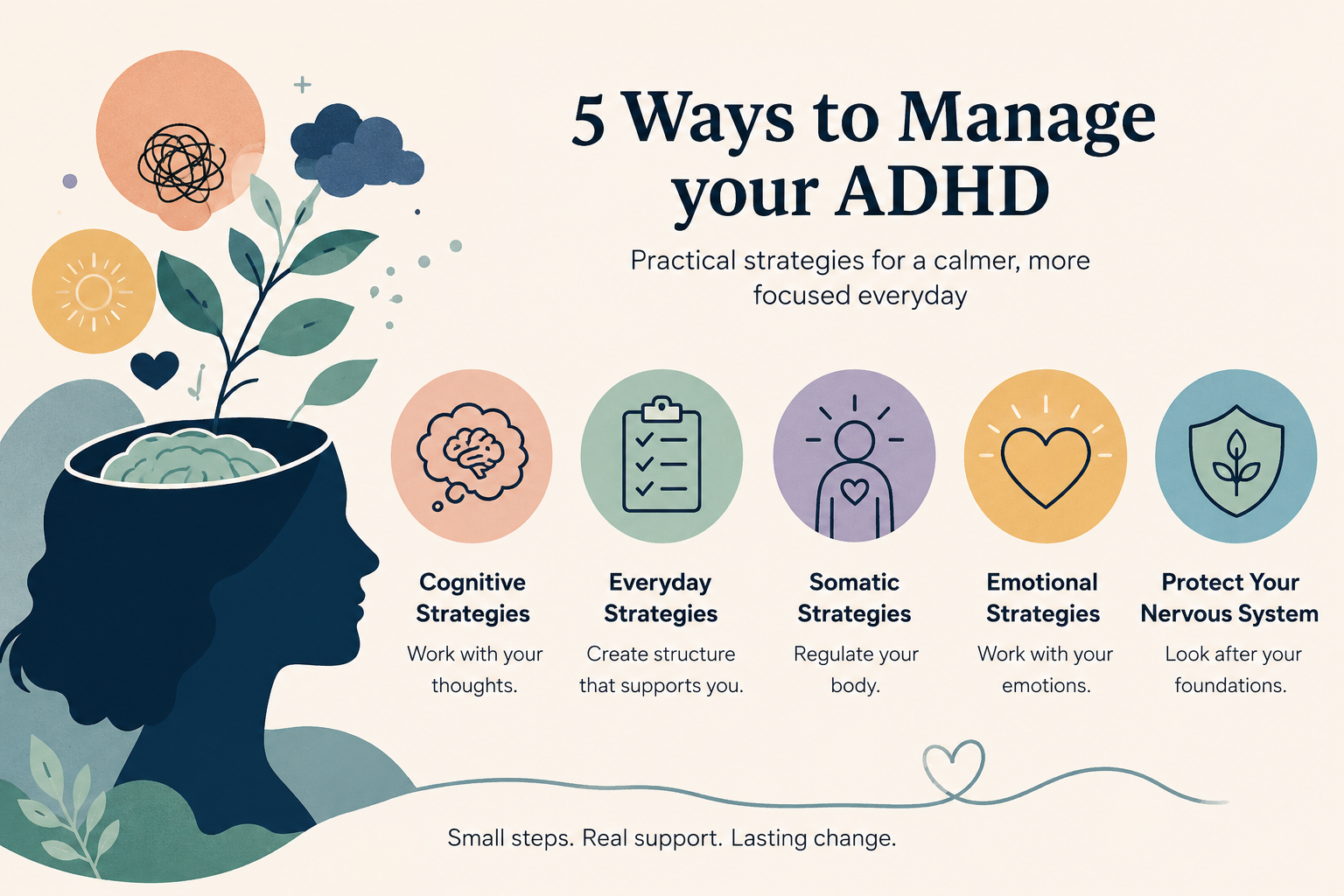
Everyday Strategies
Small changes to your environment and routines can reduce the amount of work your ADHD brain has to do. Here are some strategies that might help.
-
If something only exists inside your head, ADHD is more likely to lose it.
Use reminders instead of memory (e.g. whiteboards, sticky notes, phone reminders, calendars, checklists, voice notes)
Keep important items visible.
Break tasks into the smallest possible step.
Visual timers
Have pre-determined routines e.g. morning, work, evening
Make the first step tiny e.g. instead of ‘clean the kitchen’ try ‘put one plate away’
The fewer decisions your brain needs to make, the more energy it has for important tasks.
-
Your brain often concentrates better after movement rather than before it. Try:
walking for five minutes
climbing stairs
star jumps
stretching
resistance exercises
dancing to one song
Movement increases alertness and improves the availability of neurotransmitters involved in attention and executive functioning.
-
ADHD can make boring, repetitive or delayed-reward tasks harder to start. Rather than relying on willpower, make the task easier for your brain to engage with.
Add stimulation: Use music, movement or a change of location.
Create urgency: Use a timer or short work sprint.
Try body doubling: Work alongside someone else for structure and accountability.
Reward quickly: Use small, immediate rewards rather than waiting until everything is finished.
Make starting tiny: Focus on the first small action, not the whole task.
-
ADHD can make it harder to filter sensory input and regulate arousal. Looking after your basic physical needs can make attention and emotional regulation easier.
Prioritise sleep: Tiredness can amplify ADHD symptoms and emotional reactivity.
Eat and drink regularly: Hunger and dehydration can worsen concentration, irritability and fatigue.
Notice overstimulation: Reduce noise, screens, crowds or competing demands when you're overloaded.
Build in recovery time: Take short breaks before you reach exhaustion or overwhelm.
Use movement: Walking, stretching or other physical activity can help regulate restlessness and arousal.
-
The ADHD brain responds strongly to:
novelty
urgency
challenge
interest
immediate rewards
Where possible:
gamify boring tasks
race the timer
work alongside another person
use music
reward completion immediately
Don't rely solely on discipline. Build motivation into the task itself.
Somatic Techniques
Somatic (or body first) strategies are often better for an ADHD brain, prior to working through emotional awareness or regulation. Here are the most common ones that I start with for my clients.
-
Goal: slow your nervous system and reduce overwhelm
When to use it
Feeling anxious or overwhelmed
Racing thoughts
Strong emotions
Difficulty concentrating
Instructions
Hold one hand out in front of you. With your other hand slowly trace around each finger (like you are outlining your hand). As you trace up each finger, deeply inhale. As you trace down each finger, deeply exhale.
Why it works
Breathing or mindfulness alone is rarely effective for people with an ADHD brain. They often need an additional source of sensory or cognitive stimuli to maintain focus. The addition of the sensation on the hand helps the brain maintain focus while breathing.
Optional
You can extend this technique by also thinking about:
Thumb: just breathe
Index finger: “What am I noticing in my body right now?”
Middle finger: “What emotion am I feeling?”
Ring finger: “What do I need right now?”
Little finger: “What is one small helpful thing I can do next?”
-
Many people with ADHD find activities involving resistance surprisingly calming. Examples include:
carrying groceries
push-ups against a wall
lifting weights
resistance bands
gardening
pushing or pulling heavy objects safely
This provides strong sensory input that can improve body awareness and regulation.
-
Firm physical input can reduce feelings of restlessness. Examples:
weighted blanket (during rest)
firm self-hug
leaning firmly into a wall
squeezing a pillow
compression clothing (for some people)
Not everyone finds this helpful, but many ADHD clients report improved regulation.
-
The ADHD brain often responds well to rhythm. Try:
walking to music
drumming fingers
rocking gently
rhythmic breathing
chewing crunchy foods
fidget tools used rhythmically
Rhythm provides predictable sensory input that helps organise attention.
-
Instead of forcing yourself to sit perfectly still, give your body something appropriate to do. Examples:
stress ball
therapy putty
fidget ring
textured object
doodling while listening
standing desk
pacing during phone calls
Many people concentrate better when a small amount of movement is allowed.
Emotional Regulation
Emotions in ADHD often arrive quickly, intensely and unexpectedly. The goal isn't to stop emotions. The goal is to create enough space to choose your response.
-
Simply identifying an emotion helps engage the thinking parts of the brain. Ask yourself:
What emotion am I feeling?
How strong is it (0-10)?
Where do I notice it in my body?
This helps reduce emotional overwhelm.
-
When emotions surge:
Stop moving.
Take one slow breath.
Feel both feet on the floor.
Delay responding for one minute.
A one-minute pause is often enough for the emotional intensity to decrease.
-
If emotions are escalating:
splash cold water on your face
hold a cool drink
step outside
change rooms
stretch
walk for two minutes
Changing your physical state often changes your emotional state.
-
Several times a day ask:
Am I hungry?
Am I tired?
Am I overstimulated?
Have I moved today?
Do I need a drink?
Many emotional "blow-ups" are actually nervous system overload.
Cognitive Strategies
ADHD can make thoughts feel fast, distracting or difficult to disengage from; cognitive strategies can help you slow the mental noise, shift attention and respond more intentionally.
-
Many adults with ADHD have spent years believing they are lazy, careless or not trying hard enough. Repeated criticism often becomes an internal voice.
Instead of asking: "Why can't I do this?", try asking: "What does my brain need right now?"
That small shift changes the focus from blame to problem-solving.
-
Best for: Racing, repetitive or intrusive thoughts.
How to: Instead of treating a thought as a fact, notice it as something your brain is producing. Change “I'm going to mess this up” to “I'm having the thought that I'm going to mess this up.” You don't need to argue with the thought—notice it and redirect your attention.
Read more here.
-
Best for: All-or-nothing thinking, catastrophising and negative self-talk.
How to: Catch the thought and ask: Is there another way of looking at this? Aim for something realistic rather than artificially positive: “I've wasted the whole day” → “Today hasn't gone to plan, but I can still do one useful thing.”
-
Best for: Multiple thoughts competing for attention.
How to: When an unrelated thought appears, briefly write it on a “later” list rather than following it. Tell yourself “I don't need to deal with this now” and return your attention to what you were doing.
-
Best for: Mental overload and difficulty switching off.
How to: Imagine each unfinished thought or concern as an open browser tab. Notice each one, decide whether it needs attention now or later, and visualise closing the tabs you don't need right now. Keep only the one you're choosing to focus on open.
-
Best for: Impulsive reactions and emotionally driven thinking.
How to: When you notice the urge to immediately respond or act, stop and pause briefly. Ask: “What am I feeling? What am I about to do? What response would be most helpful?” Then choose your next action.
Final Thoughts
Managing ADHD isn't about becoming more disciplined. It's about understanding how your brain works and creating systems that support it.
The most effective strategies usually involve changing your environment, regulating your body and reducing the demands placed on working memory before expecting yourself to think differently.
Progress rarely comes from trying harder. It comes from making the next step easier.