Observing the body: what it might be trying to tell you
Having been trained in multiple different disciplines (e.g. massage therapy, psychology, and clinical aromatherapy), I have unique experience in how the mind and body interact. I’ve often noticed that emotional stress seems to show up in remarkably consistent places within the body. This isn't a map you'll find in most psychology or medical textbooks, nor am I suggesting these patterns are universal. They are observations that I (and others that trained me) have developed over years of working with hundreds of people, listening to their stories, and noticing recurring themes.
I've found these patterns useful because they encourage curiosity rather than diagnosis. When someone repeatedly develops tension in the same part of their body, I don't assume that area means something. Instead, I ask whether it might be worth exploring what is happening in that person's life alongside what is happening in their body. When a client comes to me with a problem, pain or tension in a particular part of their body, I can often tell what is going on for them by where they hold it.
Our bodies and minds are constantly communicating. Sometimes we recognise the emotional burden first. Sometimes the body notices it long before we do.
What your body might be trying to communicate
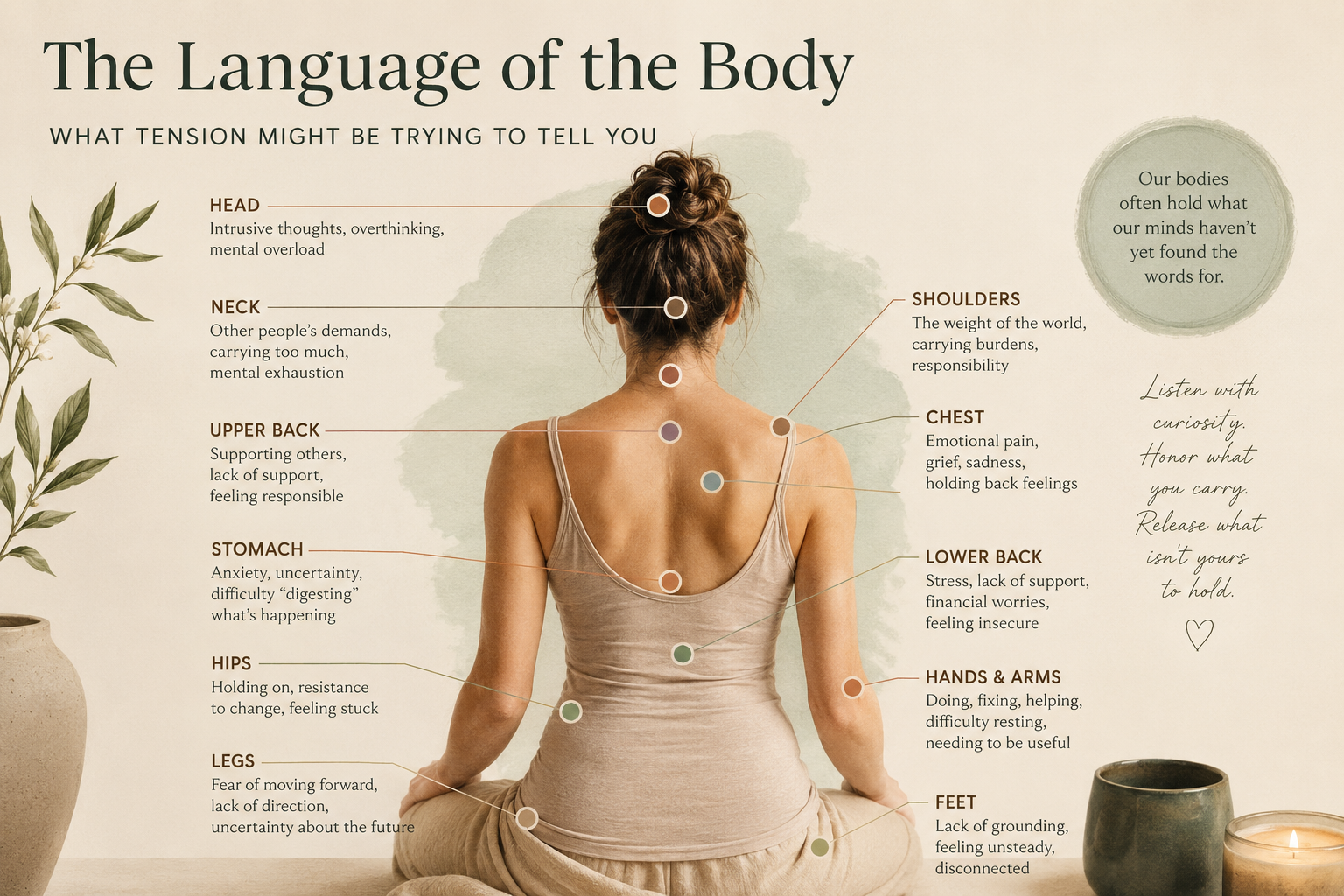
The ideas below aren't intended as rules. Think of them as conversation starters—patterns that may help you better understand yourself. Here are some of the key patterns that I have observed:
Head / temples - overloaded mind, intrusive thoughts, rumination, constantly trying to solve problems.
Jaw – unspoken words, suppressed anger, self-restraint, perfectionism.
Throat – difficulty expressing needs, emotions and thoughts, setting boundaries, or asking for help.
Base of the skull - relentless thinking, mental exhaustion, hypervigilance, weighed down by other people’s demands.
Sides of the neck - feeling pulled in different directions, chronic stress, constant alertness.
Right arm - difficulty taking action, making decisions.
Left arm - difficulty supporting others (either providing too much or too little).
Chest – vulnerability, grief, shame, love, heart-break, emotional protection, emotional fatigue (giving too much)
Shoulders – responsibility, caregiving, hyper-independence, ‘weight of the world’.
Upper back – lack of support while supporting others.
Lower back – safety, security, financial or family pressures.
Stomach – uncertainty, loss of control, "digesting" life events, chronic vigilance.
Pelvis/hips – autonomy, identity, transitions, holding versus moving forward.
Glutes – chronic bracing, feeling constantly "on guard."
Legs – confidence in moving forward, fear of change.
Feet – feeling disconnected from the world, lack of groundedness, stability or belonging.
My massage teacher also introduced the concept that the right side of the body is often associated with masculine energy and the left with feminine. Whilst some people might find this quite a wild concept, I have found that this is often the case with many of my clients. Those that experience problems primarily on the right side tend to struggle with concepts we often associate with masculinity: assertiveness, confidence, leadership, decision making, action, strength and courage. Whereas those with problems on their left side might struggle with compassion, empathy, kindness, warmth, caregiving, emotions, patience and tenderness. Like the area of body associations, these patterns are not universal, but an interesting way of thinking about what our body is trying to communicate to us.
Final Thoughts
I don't believe the body is random. Throughout my years working in both massage therapy and psychology, I've repeatedly observed that people tend to carry stress in predictable places. The specific emotions and experiences differ from person to person, but the patterns are often remarkably similar.
These observations aren't intended to diagnose or explain every ache and pain. Physical symptoms can have many causes, and persistent or unexplained pain should always be medically assessed. Instead, I hope this article encourages a different kind of question.
Rather than asking only, "How do I get rid of this pain?" you might also ask, "Why is my body holding onto it?"
Our bodies are constantly adapting to the demands we place upon them. Sometimes they compensate quietly for months or years before finally demanding our attention. When we slow down and listen with curiosity instead of frustration, pain can become more than something to eliminate—it can become a valuable source of information.
You don't have to agree with every association in this article. Instead, use them as prompts for self-reflection. If one resonates, explore it. If it doesn't, leave it behind. Ultimately, you are the expert on your own body.
Perhaps the most important message is this: your body is not working against you. More often than not, it's doing its best to communicate something your mind hasn't yet put into words.